Real Rate of Return: Formula and Examples
The real rate of return adjusts your nominal return for inflation. Here is the formula, worked examples, and why the subtraction shortcut can mislead you.
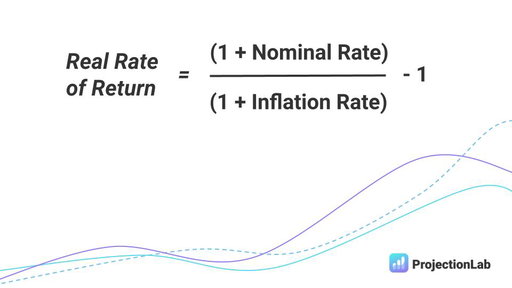
The real rate of return (or real return) is the return on an investment after adjusting for inflation. It measures what your money can actually buy at the end of the period rather than how much the account balance grew, which is why it is the number that matters for long-term goals like retirement.
A portfolio that gained 7% in a year when inflation ran 3% did not really grow 7%. Your purchasing power grew closer to 4%, and over a multi-decade horizon that gap compounds into a very large difference.
Real Rate of Return Formula
The exact formula divides growth by inflation rather than subtracting it:
Real Rate of Return = ((1 + Nominal Rate) / (1 + Inflation Rate)) - 1
How to Calculate the Real Rate of Return
Add 1 to each rate, divide the nominal figure by the inflation figure, then subtract 1. Using a 7% nominal return and 3% inflation:
(1.07 / 1.03) - 1 = 0.0388, or 3.88%
Real Return Formula Shortcut
The quick version is simple subtraction:
Real Rate (approximate) = Nominal Rate - Inflation Rate
That gives 4% here, close enough for a rough check. The approximation drifts as inflation gets larger, though: it overstates a positive real return, and it overstates the loss when inflation exceeds your return.
| Nominal | Inflation | Subtraction shortcut | Exact formula | Overstatement |
|---|---|---|---|---|
| 5% | 2% | 3.00% | 2.94% | 0.06% |
| 7% | 3% | 4.00% | 3.88% | 0.12% |
| 10% | 6% | 4.00% | 3.77% | 0.23% |
| 15% | 12% | 3.00% | 2.68% | 0.32% |
For everyday estimates the shortcut is fine. For projections that compound over decades, use the exact formula.
Why Real Returns Compound Into Large Differences
Over a single year the distinction looks academic. Over a career it is not.
Invest $100,000 for 30 years at a 7% nominal return and you end with about $761,000. That figure is in nominal terms, though. If inflation averaged 3% over the same period, the purchasing power of that balance is roughly $313,000 in today’s terms, which is exactly what $100,000 growing at the 3.88% real rate produces.
Both numbers describe the same outcome. Only one of them tells you what you can buy.
Taxes Make the Real Return Lower Still
Taxes are assessed on nominal gains, not real ones, which quietly reduces your after-tax real return by more than the headline tax rate suggests.
Say you earn 5% nominal in a taxable account while inflation runs 3%. Your real pre-tax return is about 1.94%. At a 22% marginal rate you owe tax on the full 5%, roughly 1.1 percentage points, leaving an after-tax real return near 0.87%. You were taxed on gains that partly represented inflation rather than genuine increases in purchasing power.
This is one reason tax-advantaged accounts matter more than a comparison of tax rates alone implies, and why the account a given asset sits in affects your real outcome. You can see how much tax a plan pays each year in ProjectionLab’s tax analytics.
Frequently Asked Questions
What is the formula for the real rate of return? ((1 + nominal rate) / (1 + inflation rate)) - 1. With a 7% nominal return and 3% inflation, that works out to 3.88%.
What is the historical real return of the US stock market? About 6.5% to 7% a year after inflation since 1802, according to Jeremy Siegel’s Stocks for the Long Run. Shorter stretches vary widely around that average, so a planning assumption below it builds in margin.
What are real return funds? Real return funds are mutual funds and ETFs that aim to beat inflation rather than track a stock or bond index, typically by holding inflation-linked bonds such as Treasury Inflation-Protected Securities (TIPS), sometimes alongside commodities and real estate. The name describes the goal, not a guarantee: the fund’s real return is still its nominal return adjusted for inflation.
Can the real rate of return be negative? Yes, whenever inflation exceeds your nominal return. A savings account paying 2% during 4% inflation delivers a real return of about -1.9%, meaning the balance grows while its purchasing power shrinks.
Should I use nominal or real returns in my retirement projections? Either works as long as you are consistent. If you project in real terms, keep expenses in inflation-adjusted terms and use real return assumptions. If you project in nominal terms, inflate future expenses and use nominal returns. Mixing the two, such as nominal returns against uninflated expenses, overstates how far the money goes.

Disclaimer: The content, tools, and resources on ProjectionLab.com are intended solely for informational and educational purposes and should not be construed as professional financial or investment advice. Our materials are designed to provide general guidance and are based on the input and data provided by users. ProjectionLab makes no guarantee of the accuracy, completeness, or applicability of this content to individual circumstances. Effective financial planning and investment involve comprehensive consideration of a wide array of personal financial factors. The tools and resources available on ProjectionLab are aimed at helping users develop an understanding of their financial trajectory. However, they should not be solely relied upon for creating a complete financial plan. We strongly recommend consulting a financial services professional who can provide personalized advice based on your unique financial situation before making any significant financial decisions. While we endeavor to keep the information on ProjectionLab current and accurate, the content may differ from that found on other financial institutions, service providers, or specific product sites. All content and tools on ProjectionLab are provided without any guarantees or warranties of any kind.