Plan RMDs and other required withdrawals
Required minimum distributions (RMDs) bring money out of retirement accounts even when you don’t need it for spending. Include them in your plan to see how they change your taxable income and the savings you leave invested.
Set the account’s rules
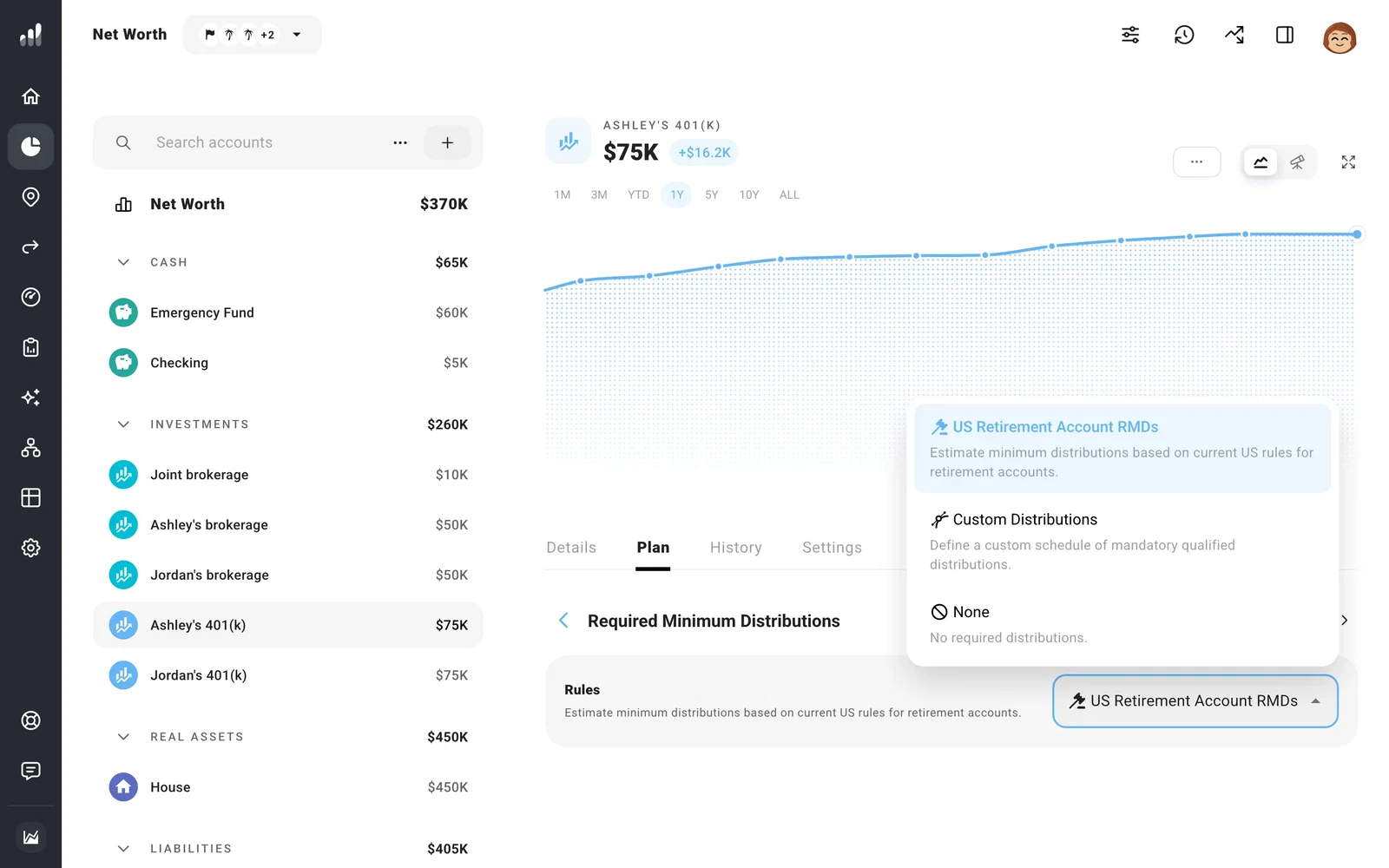
Open the retirement account on Net Worth, select Plan > Required Minimum Distributions, and choose its Rules.
Use US Retirement Account RMDs for a traditional US retirement account. The starting age follows the owner’s birth year: 73 for people born from 1951 through 1959, and 75 for those born in 1960 or later. The required amount is based on the previous year’s balance and an IRS life-expectancy factor, so it changes each year.
Your own Roth IRA and Roth workplace accounts have no lifetime RMDs. Inherited IRAs, including inherited Roth accounts, have separate beneficiary rules.
For a Canadian Registered Retirement Savings Plan (RRSP), choose Canadian RRIF Minimum Withdrawals and set RRIF Start on the account’s Plan tab. This models withdrawals after conversion to a Registered Retirement Income Fund (RRIF).
Custom Distributions lets you set a schedule as amounts or percentages. Choose None when the account should have no modeled requirement.
Count withdrawals you’ve already taken
If you’ve taken a distribution in the plan’s first year, enter it under Already took a distribution this year?. It counts toward that account’s yearly requirement, along with other qualifying withdrawals.
Open Cash Flow in an RMD year to see where the money goes. It can cover expenses, and any unused income follows your Flows and Surplus Strategy. Tax Analytics shows its effect on taxable income.
Test smaller future RMDs
Roth conversions reduce the pre-tax balance that later RMDs are based on. Compare the tax paid on conversions now with the tax on required withdrawals later. The year’s RMD comes out before conversions; the required amount itself is not eligible for conversion.
If charitable giving is part of your plan, a qualified charitable distribution (QCD) from an eligible IRA can count toward its RMD while staying out of taxable income. These start at age 70½. See Plan charitable giving to add one.
Next: Plan Roth conversions
